Blog
Podcast
How Haku Wins Mid-Market Deals by Mixing AI Speed With Human Intent
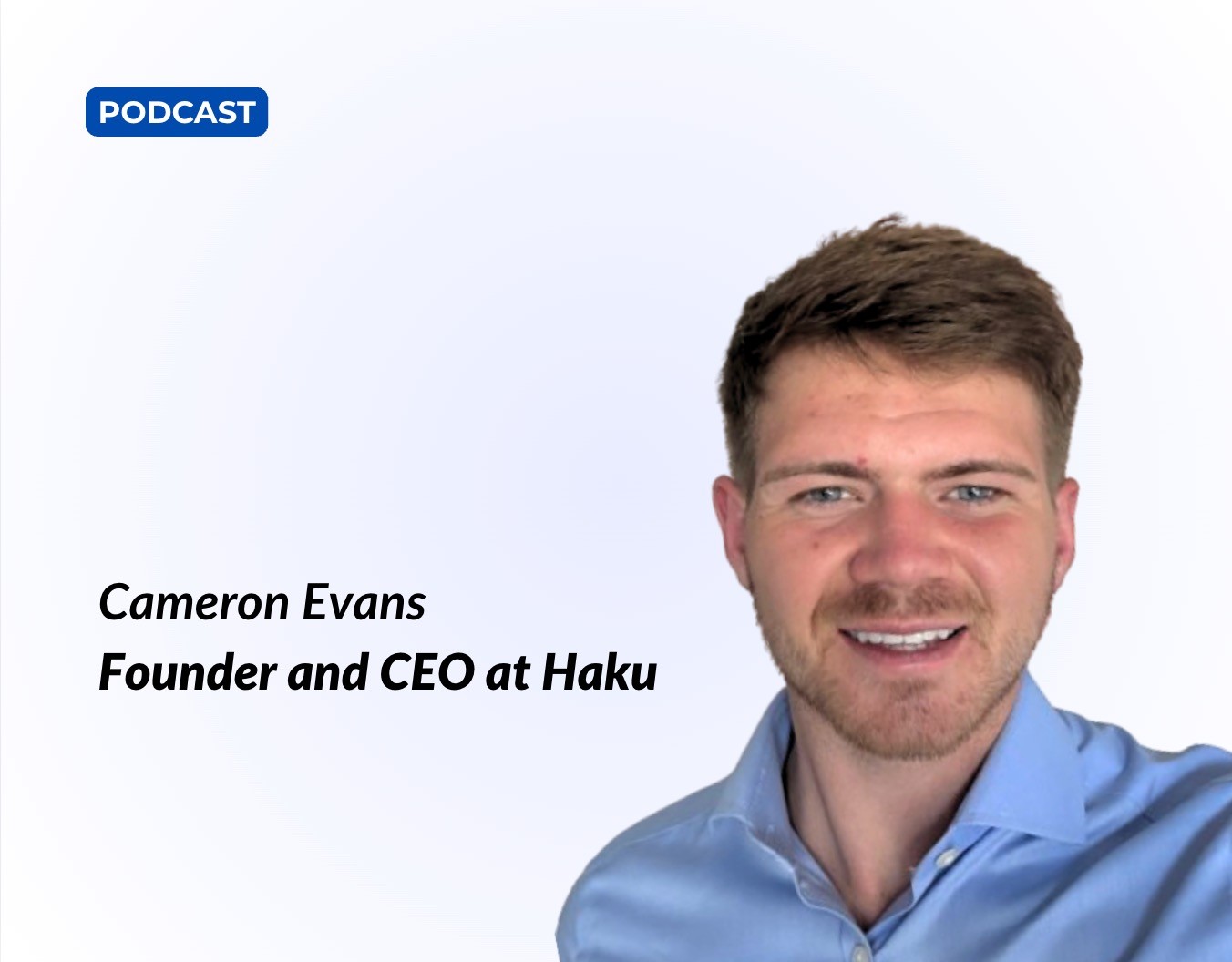
Cameron Evans explains how Haku sells GTM tech to sales leaders by combining AI-led research with human execution, plus practical ways to manage champions and stakeholders.

Mick Gosset
CEO and Co-Founder
Feb 11, 2026
In this episode of the Revenue Revolution Podcast, Cameron Evans, founder of Haku, shares how his team sells a research and prospecting engine in a crowded AI SDR and GTM tech market. The big message is consistent: AI can accelerate the workflow, but you still need human intent, credibility, and disciplined deal control to close.
Why Haku targets a clear mid-market motion
Haku sells to sales leaders, mainly Sales Directors and VPs of Sales, in SMB to mid-market organisations. Cameron frames Haku as an “always-on engine” that supports research and prospecting without forcing teams into a complicated, technical workflow.
Key deal mechanics from Cameron:
Average contract value (ACV): $15K to $30K
Typical sales cycle: ~5 to 6 weeks (with some faster exceptions around 3 weeks)
Buying group: usually 3 stakeholders
Core stakeholders: Sales Director (champion), Sales Manager or SDR lead (closest to daily pain), and CRO (final sign-off)
Cameron’s internal rule captures the reality of mid-market approval chains: “No CRO, no deal.” That single line signals the importance of executive alignment, not just rep-level enthusiasm.
How to sell AI GTM tools without sounding like every other AI tool
Cameron positions Haku away from full automation and away from high-volume sequencing as the main value. Instead, he focuses on helping teams operate faster while keeping quality and control.
His framework is simple and repeatable:
AI can reliably take you to about 70% of the workflow.
The final 30% needs human execution: judgment, empathy, and context that buyers can feel.
"We'll get your team up to that 70%, that's your real time saving value add. But that 30% is all human execution."
Cameron calls most AI outreach “mass personalization.” His point is that buyers respond more to effort and intent than templated personalisation. In GTM tech, the real differentiation is not just what the tool does, but how it helps you acquire leads, engage them, and maintain quality without losing visibility.
What makes deals stall when senior decision makers join late
Cameron explains that deals most often get stuck when a senior decision maker is looped in late and the team has to “repitch” from scratch. This is common when the working team is in one region and executive leadership sits elsewhere.
A typical stall pattern he describes:
The local champion has strong pain and momentum.
A senior approver joins later (often US HQ for SaaS companies).
The conversation resets, and value must be re-established quickly.
The hidden risk is champion weakness during executive calls. Cameron stresses the need to ask: have you empowered your champion to speak confidently when the CRO or senior leader enters? Many deals slip when the champion goes quiet, because the pain becomes less visible in the room.
How to improve multi-threading with account mapping and better messaging
Multi-threading is not just “adding contacts.” Cameron distinguishes between knowing who the stakeholders are and knowing what to say to each stakeholder to build momentum.
Haku supports multi-threading by mapping accounts using hierarchical org structures. Cameron describes using that mapping both for outbound prospecting and for navigating live deal cycles.
But he also points out the harder operational problem: sellers often know they should multi-thread, yet still struggle with the strategy. The challenge is enabling reps to “warm” each stakeholder with the right message, at the right moment, using the right proof. That is what makes multi-threading repeatable rather than random.
How to keep stakeholders aligned by understanding what changes for them
The episode highlights stakeholder management as a core closing skill in modern B2B sales, especially in GTM tech where tools are deeply connected to CRM workflows.
Cameron uses RevOps as the clearest example:
RevOps is usually juggling a large stack and keeping systems stable.
New tools can feel like they create risk, rework, and disruption.
Even when the tool is useful, RevOps may experience it as “square one again.”
His approach is to build buy-in by starting with empathy and impact:
What changes in your day-to-day if this is implemented?
Where does your stack break if one part changes?
What is the personal win for RevOps, not just the sales team?
Instead of selling “against” RevOps, he tries to bring them alongside the deal, so that when a senior decision maker joins, the call becomes “me plus two others, and you.” It is not easy, but it is the direction he aims for.
What a lost deal reveals about tech stack lock-in
Cameron shares a deal they lost that looked strong on paper because it offered significant consolidation and savings. He mentions a case where the business case suggested about $150K in savings by replacing multiple embedded tools with one solution plus CRM changes.
Why it still failed:
The customer had built processes around existing tools.
They had hired people to orchestrate and maintain the stack.
Adoption and change management risk outweighed the upside.
A director at the prospect even admitted the stack had hindered them. Cameron’s takeaway is practical: in mature environments, you may need to enter through one small use case and expand over time, rather than pushing for a full rip-and-replace.
How to spot lip service by looking for action and quantified pain
Cameron explains a unique challenge of selling to salespeople: they can “sell back” to you. That makes it harder to tell enthusiasm from genuine intent.
He does not rely on a single tell. He looks for evidence in two areas:
Action beyond the demo: willingness to take a step that creates mutual commitment
Quantified pain: willingness to share numbers that build a business case
He also stresses “actioning your buyer.” This means assigning a task between calls, not as busywork, but as a signal of seriousness. If a buyer completes the action and returns prepared, trust and momentum increase. If they avoid actions, it often indicates timing issues, curiosity-only demos, or lip service.
Cameron also shares a real timing lesson: they booked many demos at the end of December, partly because people had spare time before holidays. January did not convert as strongly because some prospects were only exploring “new shiny objects” in GTM tech.
Why sales is mostly science, but needs enough art to get started
Cameron and Mick align that sales is more science than art. Cameron estimates it leans around 80% science, grounded in evidence, process, and review.
His training approach is direct:
Put a new hire on calls for a month.
Review what was won and lost.
Backtrack through what happened, what was missed, what was said, and what was not said.
The “art” still matters early, because rapport, confidence, and a bit of flair help open doors. But Cameron warns against believing in tricks or magic openers. He sees consistent wins as the result of doing many correct things, then learning from the data.
What metrics to question and what to prioritise instead
Mick calls out stage progression as overrated because buyers do not buy in a clean, linear path, especially with larger buying groups. Cameron agrees and explains how his team uses stages as formality, not as truth.
Instead, Cameron prioritises close likelihood and scoring based on what actually happens inside the deal:
Specific events and occurrences inside each stage
Buyer actions completed or missed
Engagement quality, not just stage movement
He describes leaning more on a forecast view that forces the team to justify why a deal is 50% versus 75%. The team stays intentionally pessimistic to avoid false optimism and to build a repeatable pattern of what “real” progress looks like.
The biggest sales mistake Cameron made
Cameron shares a late-stage mistake on a large deal: he sent the wrong business case, including a Loom video, to a senior stakeholder group. The deal was multi-threaded and near the finish line, which made the error more painful.
He describes it as a “happened once, learn from it” moment, and it reinforces a core sales truth: even with high close likelihood, operational detail still matters at the end.
Conclusion
This episode is a clear playbook for selling AI GTM tools without falling into generic automation messaging. Haku’s approach is to accelerate the workflow with AI, protect quality with human execution, and keep deals moving by validating champions, multi-threading early, and demanding evidence through buyer actions and quantified pain.
Mick Gosset
CEO and Co-Founder
Share